“Whalefall” is a Stunning Fable About Emotional Survival
Sometimes a book reaches into your heart and fills a hole you didn’t know was there. That was my experience with Whalefall, Daniel Kraus’ award-winning 2023 novel. I was initially drawn to an unbelievable story of survival horror but wound up finding comfort in a surprisingly cathartic tale of grief and forgiveness. In short, I came for the whale but stayed for the tears. Brian Duffield’s intense film adaptation manages to capture the nuance of this breathtaking novel, squeezing us in the heart while simultaneously shattering our nerves.
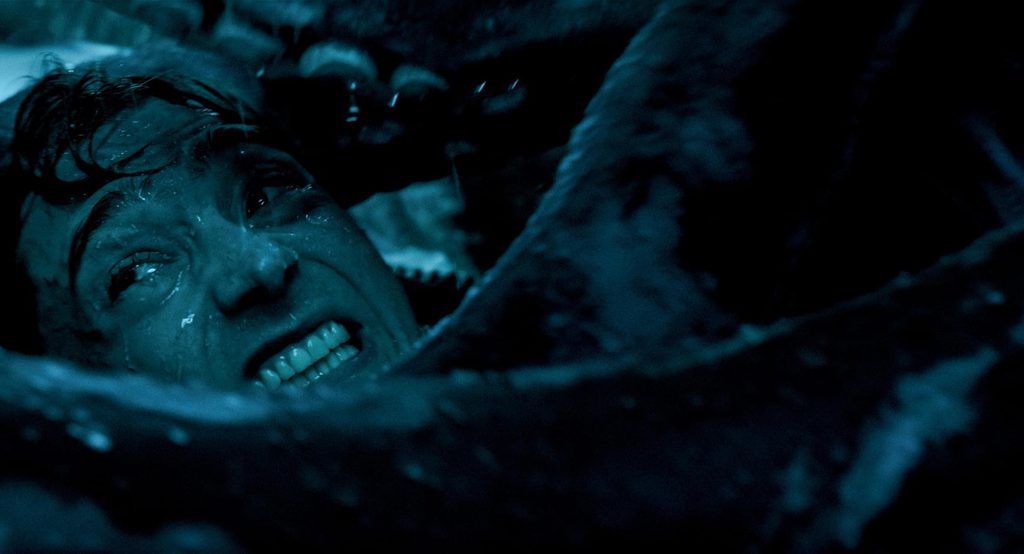
The story begins with Jay (Austin Abrams) returning to his childhood home roughly a year after his father’s death. We watch Mitt (Josh Brolin), a revered scuba diver, suffer through an unbearable coughing fit before putting on a diving belt and solemnly jumping into the sea. After refusing to mend their troubled relationship before Mitt’s passing, Jay has returned to his childhood home determined to retrieve his father’s remains. But while retracing those aquatic footsteps, Jay finds himself swept into the jaws of an enormous sperm whale. Swallowed whole, he must use his remaining oxygen and resources scavenged from inside the whale’s belly to prolong his life and find a way out.
Mirroring the structure of the book, Duffield weaves together a series of memories as Jay battles the whale’s internal organs. These flashbacks sometimes provide helpful information regarding the current predicament, but moreover, they serve as context for Jay’s emotional journey. We realize that it’s not just the whale Jay must escape but the shadow of an emotionally abusive father. Though not quite as poignant as the book, these two timelines combine in a stunning exploration of inevitability and hope as Jay realizes that he cannot reclaim the time he’s lost nor should he blame himself for his father’s mistakes.
While this relationship is the emotional core of the film, it’s framed by a truly nightmarish adventure. Abrams delivers an intense and visceral performance, relying mostly on closely framed facial expressions to convey the extent of his claustrophobia. While Jay’s body is literally chewed, crushed, and dissolved, Abrams manages to find moments of relatable humor and tender acceptance of an unthinkable demise. It’s a stunning performance from a young actor on the brink of mega-stardom.
Duffield’s direction is similarly excruciating. In early scenes we marvel at the beauty of the Northern California shore and the gorgeous Monterey Bay Kelp Forest followed by the majesty of the whale as it rises up from the ocean’s depths. Practical effects representing the whale’s insides are both grotesque and bewildering. Duffield employs masterful sound design to reflect Jay’s internal injuries. One particularly upsetting sequence sees the whale dive miles below the surface as Jay reacts to the hydrostatic pressure. It’s pure nightmare fuel, hitting terror, horror, and disgust all in one painful punch.
Fans of the novel will remember a slight metaphysical element as Jay intuits his aquatic captor’s intentions. While this sequence seamlessly flows through the book’s bifurcated narrative, it would no doubt prove dubious to transfer to the screen. But Duffield manages to make it work in a surrealist attack scene near the ocean’s floor. Those who suffer from Thalassophobia may struggle with what sometimes feels like a monstrous battle set in space, but this moment keeps the film from shifting into an action survival horror film and anchors the story in the beauty of personal discovery through impossible task.
The whale may at first appear to be a predator and this situation absolutely terrifying, but Whalefall is ultimately a story about shedding parts of yourself that no longer fit. The metaphor is right there: a boy on the brink of manhood must evade being swallowed by his own trauma. But Duffield manages to lean into earnestness while avoiding the saccharine to create a relatable story that hits us where we live. Jay’s symbolic whale may be eternal, but that doesn’t mean we can’t break free.
Jenn Adams is a writer and podcaster from Nashville, TN. Find her on social media @jennferatu.